
Why the Network State Won’t Work—and What Will Instead
Balaji's Network State won't work. This essay explains why it can't deliver on its promises and points to what will instead.

Balaji Srinivasan’s idea of the network state has become very popular among libertarians and the crypto community. It promises better governance by letting people join new jurisdictions that match their preferences, run by people who share their views. With smart contracts and blockchain technology, it would change governance in many ways.
A network state is a highly aligned online community with a shared vision that eventually crowdfunds territory, gains diplomatic recognition, and becomes a sovereign entity. Rather than forming nations through war or political revolution, a network state forms through networking, coordination, and voluntary association—enabled by digital tools.
Once enough members have joined and they’ve bought enough territory, the community negotiates permission from a host country to start its own jurisdiction. It makes an agreement with the host country, gaining rights like making its own rules, collecting taxes, and setting up its own courts. The rules of the jurisdiction are written as clear, checkable code or smart contracts — often on a blockchain. This constitution can be updated through community agreement, much like version control in software.
Three Types of Organisation
To understand the problem with the network state, we need to look at some basic economics about how organisations work.
Organisations can only take a few forms. Each form has its own strengths and weaknesses. There are three basic forms: the cooperative, the trustee system, and the proprietary system.
We all know cooperatives in the form of representative democracy. In this context, a cooperative is an organisation owned by its customers. The customers of a government collectively own it through their voting rights. Governance cooperatives — that is, representative democracies — are owned by the people they govern. Citizens get to choose who governs them. To keep this system working, voting rights can’t be sold or given away. Otherwise, someone could buy up the majority of the voting rights and gain complete control. The benefits of the cooperative would then disappear, because it would no longer be owned by its customers.
The trustee system has no ownership at all. The organisation is managed by trustees who appoint their own successors. This is what we find in nonprofits, including most universities. Trustee organisations are run according to their statutes.
The proprietary system is what we find in for-profit companies. It’s the essence of capitalism. Voting rights, in the form of shares, can be bought and sold freely. Entrepreneurs can buy large numbers of shares to gain control, like activist investors do. This system has many benefits, and our current living standards would be impossible without it.
The Problem with the Network State
A network state, as Balaji envisions it, is a cooperative. The ‘network’ — the online community — owns the state. For the community to control its government, the government must be a cooperative. This is true no matter what technology is used — blockchain, special voting systems, or anything else. The government could also be a trustee system, where the trustees are chosen once by the online community. For it to be a true trustee system, the trustees must pick their own successors. If the online community keeps choosing the trustees, it’s a cooperative. The network state is essentially a democracy with more aligned voters.
In this form, the network state still seems quite new. People can join like-minded online communities and move to special zones where their communities are in charge. This would let people enjoy governance that better matches their preferences.
Balaji refers to Charles Tiebout’s model of interjurisdictional competition as the ‘mathematical basis’ of the network state. According to Tiebout, certain conditions would force governments into an intense competition with each other that forces them to serve taxpayer preferences as efficiently as possible.
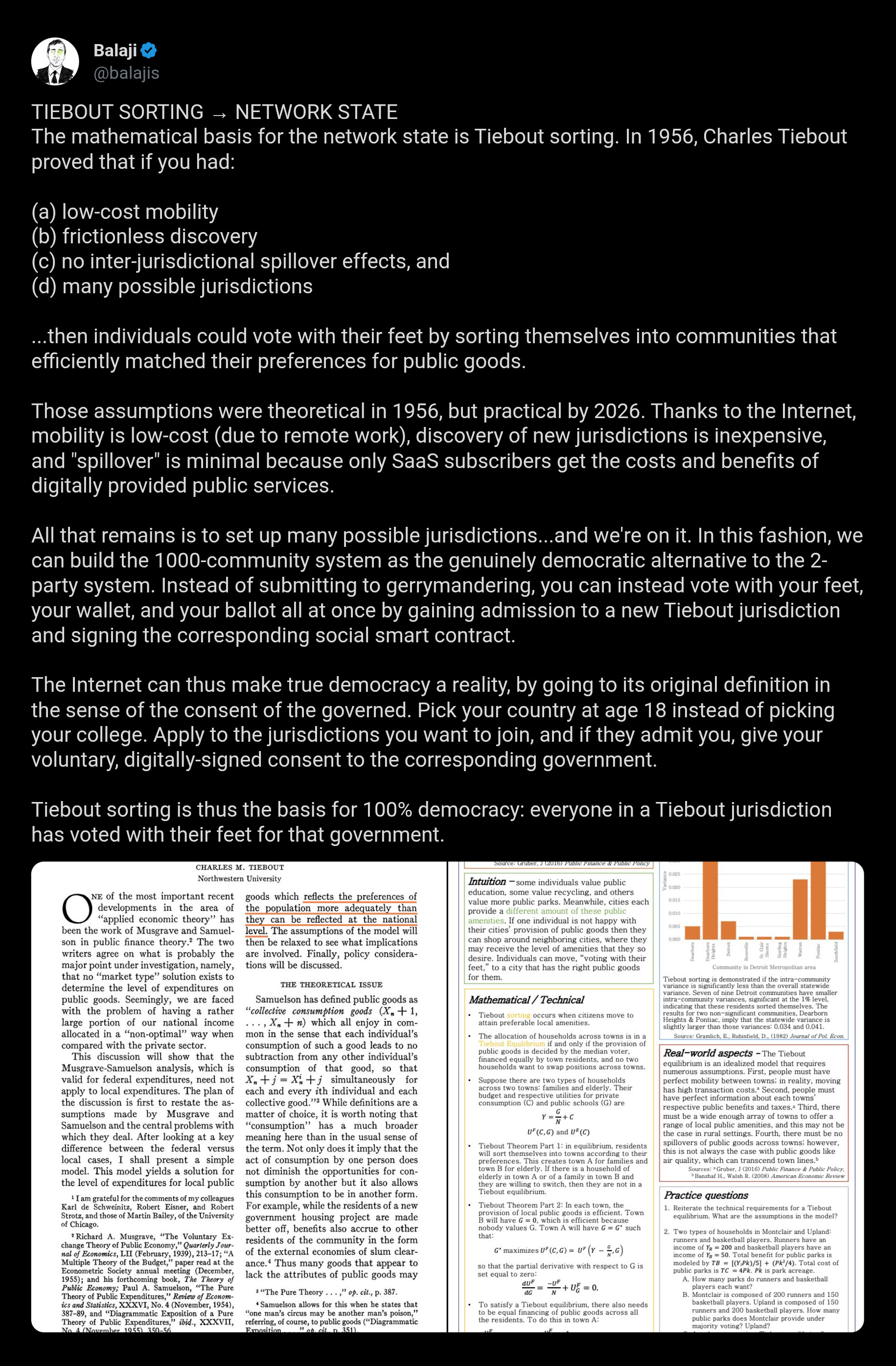
Balaji claims that the Tiebout model’s conditions hold in 2026. But he’s wrong, and so was Tiebout. The conditions don’t hold, and never will, because those conditions would mean perfect competition between governments. Governments therefore don’t behave anything like competitive service providers. As Bryan Caplan explains:
“Long story short: The still-popular Tiebout model predicts that – due to competition – local government policies will be highly economically efficient. Yet if you actually look at the world, you will see that local governments perform their core functions – education, housing regulation, and law enforcement – very poorly. Furthermore, the Tiebout model strongly predicts the virtual non-existence of local redistribution, but free public education is a massive counter-example.
To grasp what’s really going on, you must first accept that non-profit competition is far inferior to for-profit competition. The “competition” between local governments is like an academic test that doesn’t count for your grade. It’s better than nothing, but anemic compared to a standard exam where students’ futures are on the line.”

For-profits function differently from nonprofits. Only under perfect competition would this not be the case, because organisations would then be forced to serve customer preferences with total efficiency. No margins would exist to allow organisations to pursue their own priorities. But perfect competition only exists in neoclassical models, not in reality. As a result, it actually matters what kind of organisation the government is.
The problem is that bad governance has little to do with ‘sorting’ according to one’s preferences. The problems aren’t caused by a lack of options, but by representative democracy itself. In a representative democracy, voting rights are spread widely (usually ‘one person, one vote’). Therefore, nobody has a reason to act like a committed owner. In a large cooperative, your vote barely matters because thousands of others vote too, so there’s no reason to get deeply involved in government affairs. Voters usually don’t study government finances and audits, or learn about governance to choose the right leaders. This rational ignorance leads to bureaucratic bloat, corruption, and incompetent policy makers. Add the median voter’s irrationality to the mix, and politics involves ideological fights, xenophobia, and many other problems.
The trustee system also suffers from many of these problems, plus the community loses all say once the trustees are chosen. Trustees and their successors then govern as they wish within their founding rules. This system has the same bloat and corruption as the cooperative, but also adds the problem of mission drift. As trustees are gradually replaced by new trustees, these organisations slowly move away from their original purpose.
These problems exist in cooperatives and trustee systems no matter what technology is used or whether the community shares the same views.1 They also apply to the network state, because the network state is a cooperative. People might be happier with a network state because voters then agree on more things. But why keep all the other problems of these systems when there’s a better option?
The Proprietary Government versus the Network State
A proprietary government is a government with shareholders instead of voters. Shares are different from democratic voting rights because they can be bought and sold. People can transfer them to others and buy up large numbers. This makes it impossible for an organisation to be both proprietary and a cooperative. In a cooperative, voting rights must be impossible to accumulate. Voting rights are typically distributed according to the ‘one person, one vote’ rule. A proprietary government also can’t be a trustee system, because trustee systems have no ownership at all.
Voting rights in the proprietary system can be bought up by entrepreneurs and investors, which leads to voting power being held by fewer people. This reduces the problem of rational ignorance, because voting well actually matters to each individual voter when their vote has more impact. Besides, successful entrepreneurs and investors are more capable than the average voter. To get the money needed to buy large numbers of shares, you need to be good at investing or running a business (except for those who inherit money, but they usually have their wealth managed by capable investors). A proprietary system is therefore run by people who are more capable, and whose interests are better aligned with the owners because the owners are more capable and committed. That is what gives this system its strengths.
Ownership in a proprietary system usually ends up with people who seek profit, because they are the ones who have (or manage) the money to buy large numbers of shares. They want to serve as many different groups as possible, because every person who leaves is a lost customer. A proprietary government wants to give people the rules they most prefer so they’ll be willing to pay more in taxes. The proprietary system therefore has the same benefits as the network state — it serves the wants and wishes of as many people as possible. And if no two groups can be served perfectly at the same time, a proprietary government has reason to split its jurisdiction into separate zones with different rules. This lets it better satisfy different customer groups.
The network state might have these benefits, but where it does, a proprietary government does it better. A proprietary government doesn’t suffer from the problems of cooperatives and trustee systems, but the network state does.
A network state can’t be proprietary. As in any proprietary system, voting rights would be bought up by profit-seeking investors. The community would then lose control to investors. Within any constitutional limits, shareholders would serve other groups besides the online community. The network state therefore has to be a democracy or a trustee organisation, with all the problems inherent in those systems: corruption, bureaucratic bloat, poor policy making, too much public borrowing, regulatory capture and much more. It’s unlikely to be much better than the states we already know. A network state may let people move to a place where people have similar preferences, but a proprietary government also wants to serve these preferences and is better at doing so.
Are They Really Network States?
Many projects are called network states while they’re not. Some people call Próspera a network state, but Próspera is a (semi-)proprietary jurisdiction. Próspera isn’t a network state in any way. It wasn’t founded by an online community and isn’t run by one. It’s actually run by Honduras Próspera LLC. and was created to raise the living standards of Hondurans, not to serve global misfits (though they’re also welcome and have much to gain).
Próspera does an amazing job. It’s the best example of what proprietary governments can offer the world. Taxes are low, rules are simple but very effective, starting a business is cheap and easy, filing your tax returns takes a few minutes, it has a world-class arbitration system, and it’s very safe and clean. This is proprietary governance in action, and I hope many more places like Próspera will emerge. Proprietary governments can lift millions, if not billions, out of poverty.
There are other initiatives that call themselves network states but clearly aren’t. They have no jurisdictions and are rarely run by an online community. Praxis is a good example. It calls itself a network state, even an online nation, but it has no jurisdiction and its online community is not in control. Unlike Próspera, Praxis has no zone where it can make its own rules. It seems they’re thinking about starting their new city in the Dominican Republic. The DR has other large developments (like Larimar City), but without any of the grandiose language and without the bad reputation that has scared many people off. It’s not surprising that none of these projects actually involve governance, because proprietary jurisdictions and network states are illegal almost everywhere. We first need enabling legislation, like the ZEDE law in Honduras. If our goal is to create better jurisdictions — and this is a very important cause — we should follow Próspera’s example and bring this form of governance to more countries.
This sector faces two problems. First, too few countries have enabling legislation. We must work to get such laws passed, especially in countries that need proprietary governance most. Some people think you can just ‘strike a deal’ with a country, but that’s not how it works in most places. Where it does work that way, it probably involves a country with no rule of law, which is risky. In the developed world, laws and constitutions must be changed, and that takes years. Second, there are too few entrepreneurs in this sector. Besides Próspera, there’s Tipolis and maybe a few small companies that have only just started or are doing something related. We need more people like Erick Brimen and his co-founders, and more people like the institutional innovators behind the ZEDE law. Let’s focus on that.
The Proprietary State, Out Now
If you’re interested in the idea of proprietary government, I recommend my book, The Proprietary State. You can download it for free on my website or buy it on Amazon. The Proprietary State is about 330 pages of economic theory and may be the most radical economics book you’ll ever read. It challenges many established ideas in economics and political science. At its core, it explains the pros and cons of privatising a jurisdiction, how to get the most benefit and reduce the downsides, how to privatise a government, and which versions of the proprietary jurisdiction are possible. It offers a new foundation for economic theory and a new Austrian theory of entrepreneurship, and much more. If you’re interested in economics and political science, you’ll find it worth reading and very different from anything you’ve read before. Read more about it here.
For more about the problems in cooperatives and trustee systems (noncapitalist institutions):
Really sharp critique of the network state concept. Your point about rational ignorance still applying even when voters are aligned is key—I hadn't thought through how that problem persists regardless of preference sorting. The Tiebout critique is solid too; local governments compete but not efficiently because they're still cooperatives. What strikes me though is the transition risk with proprietary governance. Próspera works partly because Honduras let it happen, but how many developing countries would actually pass enabling legislation when it threatens existing power structures? The examples you cite (DR developments without grandiose language) suggest entrepeneurs might succeed more by being less ideological about it